


Your shopping cart is empty!
Petunia "Gioconda Purple-White" F1
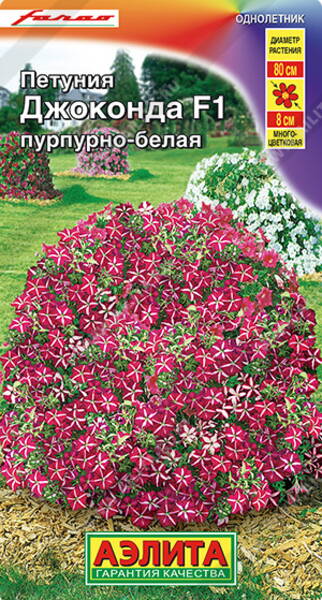
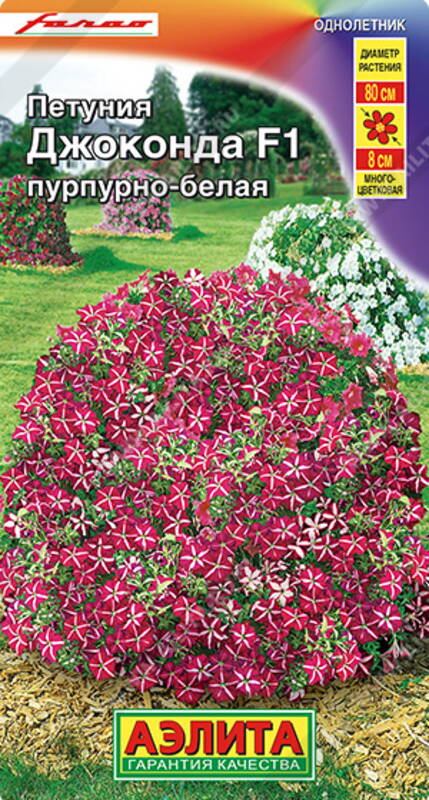
Petunia "Gioconda Purple-White" F1 - Petunia multiflora.
A breakthrough in breeding: a petunia that can bloom all year round!
Multiflora trailing cascade petunia.
A petunia of Italian breeding by the "Farao" company with unsurpassed characteristics. Thanks to the male sterility gene, it produces a staggering number of flowers and blooms continuously from spring to late autumn.
Flowers with a spectacular "star" pattern are not damaged by rain and wind. The Gioconda series petunia is a serious competitor to surfinias, which can only be propagated vegetatively. It will decorate flower beds, borders, hanging baskets, and garden vases.
Height 20 cm. Flower diameter 6-8 cm. Length of the plant 80-100 cm.
Gioconda is the world's first petunia that produces a staggering number of flowers due to male sterility (does not produce seeds), which creates competition for petunias and surfinias that reproduce by cuttings. Plants with incredibly powerful branching shoots (covering the soil up to 1 meter in diameter, at a height of 20 cm), are covered with a huge number of flowers. When grown in pots, the shoots cascade over the edges.
Gioconda petunia is able to adapt to a wide range of temperatures – from +8 to +40°C. When the temperature drops, the plants do not die, but only slow down growth and flowering.
By maintaining optimal growing conditions (11-hour daylight and temperature +20...+22°C), you can keep the plants blooming all year round, which provides new opportunities in decorative landscaping.
Ideal for greenhouse seedling production: plants are uniform, very strong, and, most importantly, flowering begins at an early stage. Ideal for growing in pots, hanging baskets, and in the open ground.
Sowing: seeds in pelleted form!
In order to facilitate the sowing and cultivation of small-seeded crops, a system was developed to coat each seed with a special compound. When moisture hits the pellet – the shell crumbles. Sow in February-March for seedlings. The pellets are placed on the surface of slightly compacted and moistened soil without embedding them, moistened from a sprayer, covered with glass and kept at a temperature of +20...+24°C, preventing the pellet shell and compost from drying out until the seedlings germinate, and periodically removing condensation drops from the glass surface. Seedlings appear only in the light (excluding direct sunlight) on the 10-15th day. After the appearance of the first true leaf, the crops are ventilated. In the future, the glass is removed, gradually reducing the temperature to +14...+16°C. Seedlings do not tolerate high temperatures and waterlogging well. Hardened seedlings are planted in the ground after the end of spring frosts at a distance of 15-20 cm.
Care: grows best in well-lit areas with light, fertile soil. Responds gratefully to watering and regular feeding.
Flowering: from June until frost.
A breakthrough in breeding: a petunia that can bloom all year round!
Multiflora trailing cascade petunia.
A petunia of Italian breeding by the "Farao" company with unsurpassed characteristics. Thanks to the male sterility gene, it produces a staggering number of flowers and blooms continuously from spring to late autumn.
Flowers with a spectacular "star" pattern are not damaged by rain and wind. The Gioconda series petunia is a serious competitor to surfinias, which can only be propagated vegetatively. It will decorate flower beds, borders, hanging baskets, and garden vases.
Height 20 cm. Flower diameter 6-8 cm. Length of the plant 80-100 cm.
Gioconda is the world's first petunia that produces a staggering number of flowers due to male sterility (does not produce seeds), which creates competition for petunias and surfinias that reproduce by cuttings. Plants with incredibly powerful branching shoots (covering the soil up to 1 meter in diameter, at a height of 20 cm), are covered with a huge number of flowers. When grown in pots, the shoots cascade over the edges.
Gioconda petunia is able to adapt to a wide range of temperatures – from +8 to +40°C. When the temperature drops, the plants do not die, but only slow down growth and flowering.
By maintaining optimal growing conditions (11-hour daylight and temperature +20...+22°C), you can keep the plants blooming all year round, which provides new opportunities in decorative landscaping.
Ideal for greenhouse seedling production: plants are uniform, very strong, and, most importantly, flowering begins at an early stage. Ideal for growing in pots, hanging baskets, and in the open ground.
Sowing: seeds in pelleted form!
In order to facilitate the sowing and cultivation of small-seeded crops, a system was developed to coat each seed with a special compound. When moisture hits the pellet – the shell crumbles. Sow in February-March for seedlings. The pellets are placed on the surface of slightly compacted and moistened soil without embedding them, moistened from a sprayer, covered with glass and kept at a temperature of +20...+24°C, preventing the pellet shell and compost from drying out until the seedlings germinate, and periodically removing condensation drops from the glass surface. Seedlings appear only in the light (excluding direct sunlight) on the 10-15th day. After the appearance of the first true leaf, the crops are ventilated. In the future, the glass is removed, gradually reducing the temperature to +14...+16°C. Seedlings do not tolerate high temperatures and waterlogging well. Hardened seedlings are planted in the ground after the end of spring frosts at a distance of 15-20 cm.
Care: grows best in well-lit areas with light, fertile soil. Responds gratefully to watering and regular feeding.
Flowering: from June until frost.